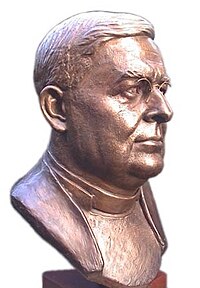
William Temple Love Quotes and Sayings
Posted on Oct 08, 2008 under Archbishop of Canterbury, Archbishop of York, Bishop of Manchester, Christ and Our Enemies, Christianity and Social Order, Church of England, Priest, W, William Temple | No Comment1. The greatest pleasure of life is love.
—————————————-
Excerpt from Wikipedia: William Temple (15 October 1881 – 26 October 1944) was a priest in the Church of England. He served as Bishop of Manchester (1921–29), Archbishop of York (1929–42), and Archbishop of Canterbury (1942–44).
Temple was the second son of Archbishop Frederick Temple (1821–1902). He was educated at Rugby School and Balliol College, Oxford, where he obtained a double first in classics. He was a fellow and lecturer in Philosophy at The Queen’s College, Oxford from 1904–10, and was ordained priest in 1909. Between 1910 and 1914 he was Headmaster of Repton School after which he returned to being a full time clergyman, becoming Bishop of Manchester in 1921 and Archbishop of York in 1929. In 1932–33, he gave the Gifford Lectures.
A renowned teacher and preacher, Temple is perhaps best known for his 1942 book Christianity and Social Order, which set out an Anglican social theology and a vision for what would constitute a just post-war society. Also in 1942, with Chief Rabbi Joseph Hertz, Temple jointly founded the Council of Christians and Jews to combat anti-Jewish bigotry.
Temple defended the working-class movement and supported economic and social reforms. As the first President (1908–1924) of the Workers’ Educational Association he joined the Labour Party. He also participated in the ecumenical movement, took part in the Lausanne Conference of 1927, and helped prepare the World Conference of Churches in Edinburgh, 1937.
One of his more famous sayings (though it is hard to pin down a source) is that,
“The Church is the only society that exists for the benefit of those who are not its members.“
He is also the author of the quote:
“Worship is the submission of all of our nature to God. It is the quickening of conscience by His holiness, nourishment of mind by His truth, purifying of imagination by His beauty, opening of the heart to His love, and submission of will to His purpose. And all this gathered up in adoration is the greatest of human expressions of which we are capable.”
However, he also refused to condemn the Allied blanket bombing of Germany, to the dismay of his numerous Quaker connections, by writing an introduction to “Christ and Our Enemies“, published by the Fellowship of Reconciliation in 1941, citing the fact that he was “not only non-pacifist but anti-pacifist”. (Citation: W. Temple papers 51,, Temple to Hobhouse, 26 March 1944; also Melanie Barber, “Tales of the Unexpected: Glimpses of Friends in the Archives of Lambeth Palace”, Journal of the Friends Historical Society, Vol 61, No.2)
—————————————-
Famous Sayings by William Temple
1. Man’s wisdom is his best friend; folly his worst enemy.
2. Our present time is indeed a criticizing and critical time, hovering between the wish, and the inability to believe. Our complaints are like arrows shot up into the air at no target: and with no purpose they only fall back upon our own heads and destroy ourselves.
3. The best rules to form a young man, are, to talk little, to hear much, to reflect alone upon what has passed in company, to distrust one’s own opinions, and value others that deserve it.
4. The first glass is for myself, the second for my friends, the third for good humor, and the forth for my enemies.
5. The first ingredient in conversation is truth, the next good sense, the third good humor, and the fourth wit.
6. The only way for a rich man to be healthy is by exercise and abstinence, to live as if he were poor.
7. There cannot live a more unhappy creature than an ill-natured old man, who is neither capable of receiving pleasures, nor sensible of conferring them on others.
8. When all is done, human life is, at the greatest and the best, but like a froward child, that must be played with and humored a little to keep it quiet till it falls asleep, and then the care is over.
Leave a comment